Marine Ceramic Coating in Tampa Bay: Long-Term Protection for Your Boat
Owning a boat in Tampa Bay comes with amazing access to the water, but it also exposes your vessel to some of the most damaging environmental conditions possible. Saltwater, intense sun, and constant moisture can quickly break down your boat’s finish, leaving behind oxidation, staining, and fading that only worsens over time.
At Conforti Auto & Marine Detailing, our marine ceramic coating services are designed specifically for these conditions. We focus on protecting gel coat and painted surfaces with a long-lasting barrier that helps your boat maintain its appearance while significantly reducing maintenance.
What Makes Marine Ceramic Coating Different?
Unlike automotive coatings, marine ceramic coatings are formulated to withstand constant exposure to water, salt, and UV radiation. Boats face a completely different set of challenges compared to cars or RVs, which is why proper product selection and application are critical.
A professionally applied marine coating creates a protective surface that:
- Resists saltwater corrosion and mineral buildup
- Slows oxidation on gel coat and fiberglass
- Enhances gloss and depth on hull surfaces
- Repels water to reduce spotting and streaking
- Makes routine cleaning significantly easier
This combination of protection and performance is especially important in a coastal environment like Tampa Bay, where exposure is constant rather than occasional.
Why Boats in Tampa Bay Require Extra Protection
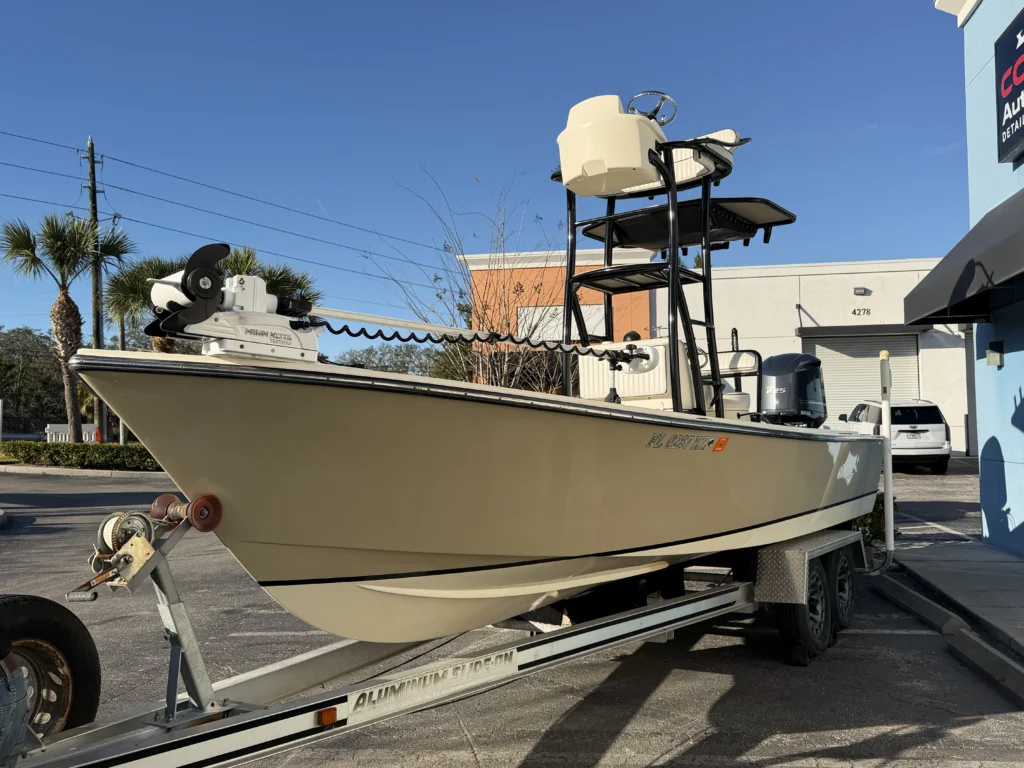
Most boats we work on in Tampa Bay start showing early oxidation on horizontal surfaces first, especially when stored uncovered. Boats in this region don’t just deal with normal wear — they face a continuous cycle of environmental stress that accelerates deterioration.
Saltwater exposure is one of the biggest contributors to surface damage, as it leaves behind deposits that eat into the finish over time. On top of that, Florida’s UV intensity breaks down gel coat quickly, leading to the chalky, faded look many boats develop after just a few seasons. Add in humidity and airborne contaminants, and it becomes clear why unprotected surfaces degrade so rapidly. In many cases, by the time oxidation is visible, it already requires multi-stage correction to fully restore the finish.
Ceramic coating helps interrupt that cycle by creating a barrier between your boat and the elements, allowing you to preserve both appearance and structural integrity of the finish.
Our Marine Ceramic Coating Process
Every boat is evaluated based on its condition before we begin, because proper preparation is what determines how well the coating performs long-term.
We start with a deep cleaning process to remove salt residue, algae, and embedded contaminants from the surface. This is followed by gel coat correction and polishing, where we address oxidation, dullness, and imperfections to restore clarity and gloss. Once the surface is fully corrected, we prepare it for coating by removing any remaining oils or residues.
The ceramic coating is then carefully applied to ensure even coverage and proper bonding across all treated surfaces. After application, the coating is allowed to cure, locking in protection and creating a durable, hydrophobic finish.
This process ensures that the coating doesn’t just sit on the surface but actually bonds to it, providing long-term durability in harsh marine conditions.
Key Benefits of Marine Ceramic Coating
Boat owners in Tampa Bay are turning to ceramic coating because it addresses multiple problems at once.
- Reduced oxidation and UV damage on gel coatReduced oxidation and UV damage on gel coat
- Easier removal of salt, algae, and grimeEasier removal of salt, algae, and grime
- Improved gloss and overall appearanceImproved gloss and overall appearance
- Less frequent need for waxing and polishingLess frequent need for waxing and polishing
- Faster and more efficient cleaning after useFaster and more efficient cleaning after use
How Marine Ceramic Coating Improves Boat Maintenance
One of the biggest frustrations for boat owners is how quickly surfaces get dirty and how difficult they are to clean. Salt residue sticks, water spots form easily, and contaminants bond to untreated surfaces in a way that requires heavy scrubbing.
With a ceramic coating applied, the surface becomes much more resistant to buildup. Water beads and rolls off, carrying contaminants with it, while anything that does remain can be removed with far less effort. This transforms routine cleaning from a time-consuming task into a much more manageable process, especially for larger boats with more surface area.
Is Marine Ceramic Coating Worth It?
For boat owners who regularly use their vessel in Tampa Bay, ceramic coating is one of the most effective ways to protect against long-term damage. The combination of saltwater exposure, sun, and moisture creates a harsh environment that quickly wears down unprotected surfaces.
By applying a ceramic coating, you reduce the need for constant maintenance while also protecting against costly restoration work in the future. The time saved on cleaning, combined with the preservation of your boat’s finish, makes it a practical investment rather than just a cosmetic upgrade.
Who Benefits Most from Marine Ceramic Coating?
Ceramic coating is especially valuable for boat owners who use their vessel frequently or keep it exposed to the elements.
- Boats stored in marinas or outdoor liftsBoats stored in marinas or outdoor lifts
- Vessels used in saltwater regularlyVessels used in saltwater regularly
- Owners looking to preserve resale valueOwners looking to preserve resale value
- Boats that have recently undergone gel coat restorationBoats that have recently undergone gel coat restoration
- High-end or newer boats where appearance mattersHigh-end or newer boats where appearance matters
What Marine Ceramic Coating Does NOT Do
Marine ceramic coating is a powerful form of protection, but it’s important to understand what it is not designed to do. It enhances and preserves your boat’s finish, but it does not replace proper maintenance or repair underlying issues.
Ceramic coating will not remove oxidation, scratches, or surface damage on its own. Any fading, chalkiness, or imperfections in the gel coat must be corrected before the coating is applied, otherwise those defects will remain visible underneath the coating. It also does not make your boat scratch-proof. While it can help reduce minor swirl marks and light surface marring, it will not prevent damage from impacts, docking, or abrasive contact.
It’s also not a replacement for bottom paint or anti-fouling protection. Marine ceramic coatings are designed for above-water surfaces like the hull sides, topsides, and fiberglass components, but they are not intended to prevent barnacle growth or marine buildup below the waterline.
Additionally, while ceramic coating significantly reduces maintenance, it does not eliminate the need to wash your boat. Salt, dirt, and environmental contaminants will still accumulate over time, but they will be much easier to remove compared to an unprotected surface.
Understanding these limitations is important, because when ceramic coating is applied correctly and maintained properly, it delivers long-term protection and makes ownership significantly easier—it just works best as part of a complete care and maintenance approach rather than a one-step solution.
- Boat
- Ceramic Coating
Serving Tampa Bay Boat Owners
Conforti Auto & Marine Detailing provides marine ceramic coating services throughout the Tampa Bay area, working with boat owners who want reliable protection against the region’s harsh conditions. From coastal communities to inland storage locations, we understand how environmental exposure varies and tailor our approach accordingly.
Whether your boat is kept on a lift, stored at a marina, or transported regularly, our goal is to provide a coating solution that fits your usage and delivers consistent protection over time. We work with a wide range of vessels and focus on delivering results that hold up in real-world conditions, not just immediately after application.

Frequently Asked Questions
Conclusion: Protect Your Boat from Tampa Bay’s Harsh Conditions
Boating in Tampa Bay offers incredible experiences, but it also comes with constant exposure to elements that can quickly wear down your vessel’s appearance. Without proper protection, saltwater, UV rays, and contaminants will gradually degrade your boat’s finish, leading to costly restoration work over time.
Marine ceramic coating provides a long-term solution by creating a durable, protective barrier that helps maintain your boat’s condition while reducing the effort required to keep it clean. Instead of constantly fighting against oxidation and buildup, you’re preserving a surface that is built to withstand the environment.
At Conforti Auto & Marine Detailing, the focus is on delivering results that last beyond the initial application. With the right preparation and coating process, your boat stays protected, looks better, and requires less maintenance, allowing you to spend more time enjoying it on the water.